Do micro-tears make the muscle grow bigger?
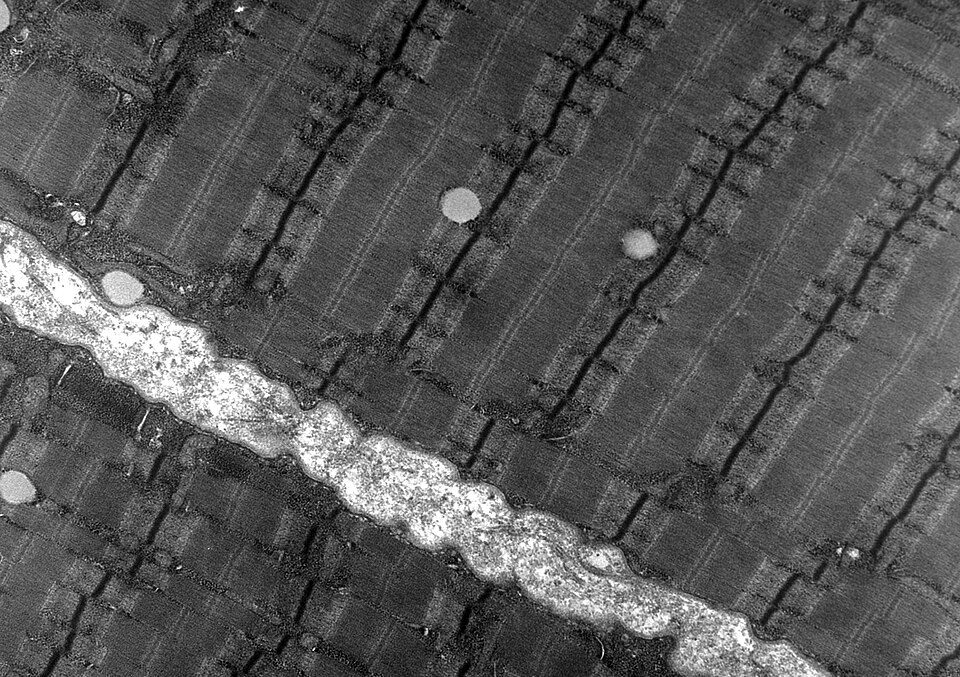
Louisa Howard (Dartmouth College) · Domaine public (recadrée)
It is often repeated that muscles grow because we "tear" them during training, and then they repair themselves bigger. Micro-tears do exist, especially at first and after slow descents, but they are not what makes the muscle grow. Programs that damage nothing yield the same gains, and soreness tells us almost nothing about the damage. You do not need to be in pain to make progress. Here is what twenty studies measure.
Where the idea of "tears" comes from
An unusual exercise damages the muscle, and a 2012 review reminds us that the greatest damage comes from the eccentric phase, when the muscle brakes a load while lengthening. This damage ranges from a few affected molecules up to ruptures of the membrane and the contractile elements. Hence the hypothesis: the inflammation and protein turnover that follow would be necessary for growth. The same review notes that other researchers dispute this, because muscle is seen building up almost without damage. This is what the trials ended up testing.
The same muscle gain, with or without damage
The most direct trial, published in 2011, is entitled "no pain, no gain?". Two groups do eight weeks of eccentric cycling, three 20-minute sessions per week, with the same total work. The first increases the load for three weeks, so progressively that no damage is detectable. The second starts with a damaging session: creatine kinase (a marker of injury in the blood) more than five times higher, and soreness. In the end, muscle cross-sectional area and volume increased just as much in both groups, and strength as well: +25% against +26%. The authors conclude that muscle building can start without any noticeable damage.
In 13 beginner men, four weeks of solely concentric weight training (lifting, without braking the descent) caused neither soreness nor signs of edema on ultrasound. Yet muscle thickness increased by 0.23 cm as early as the sixth test, and lean mass by 109 g at the seventh. With a blood flow restriction band, light loads (30% of maximum) even increased muscle activation and swelling without touching damage markers; to go further, see blood flow restriction training.
What the muscle really does in the first few weeks
One trial followed 10 young men for 10 weeks of weight training, with biopsies. In the first week, microscope-visible damage is at its highest, and muscle protein synthesis as well, but it has no connection to final growth. By the 3rd week, damage has dropped, and by the 10th it is minimal; only then does protein synthesis closely track growth (r ≈ 0.9). And the fibers only grew in a measurable way by the 10th week.
Did you know?
What about the muscle that "grows" from the very first weeks? In the same group, thigh cross-sectional area increased by about 2.7% at the 3rd week and 10.4% at the 10th. But at the 3rd week, ultrasound showed edema, with elevated damage markers (myoglobin, interleukin-6): a good part of this early gain is swelling, not muscle yet. Maximum strength only increased at the 10th week.
2016 trial, 10 young beginner men
The 2018 review breaks down progression as follows: up to 4 sessions, the increase in muscle cross-section comes mainly from damage-related swelling; around 10 sessions, modest hypertrophy appears; it is after about 18 sessions that true hypertrophy is observed. It adds that protocols that barely damage the muscle yield size and force gains similar to those that damage it.
Swelling and growth are actually quite distinct. In nine men who performed three curl sessions in 8 days, resting biceps thickness increased by about 0.21 cm after the first session, then did not move anymore; only swelling right after each session distinguished it from the arm that did not train, and an already swollen muscle could almost no longer swell further. Strength, meanwhile, remained lower than baseline until the last measurement.
Soreness does not measure damage
In 110 students who performed 12, 24, or 60 maximal eccentric contractions of the elbow flexors, 24 and 60 repetitions caused markedly greater strength loss and creatine kinase than 12. Yet tenderness to palpation and when bending the arm did not differ between groups. The links between soreness and other damage markers were weak (r less than 0.32). Authors' conclusion: soreness poorly reflects damage, and damage markers can move without soreness.
In 20 men, an intense eccentric cycling session and a light eccentric cycling session, at the same total work, caused the same loss of strength the next day (about 10% in isometry), but soreness was greater after the intense version. And in a five-day exertion trial, creatine kinase rose more in trained individuals than in beginners, whereas it was the beginners who hurt the most, and the earliest.
"No pain, no gain": false
Why you hurt less the second time
A single eccentric session protects the muscle against the damage of the next one: this is the "repeated bout effect". A 2003 review classifies explanations into three families: the nervous system, muscle stiffness, and changes within the muscle itself, such as the addition of sarcomeres (the small units that contract) and better-contained inflammation. A 2017 review suggests that these mechanisms act together; none explains it alone.
It takes very little to trigger this protection. In 34 students, a first session of only 6 maximal eccentric contractions protected as much as one of 24 against a session of 24 done two weeks later, and even 2 contractions gave partial protection. In 16 men, 10 contractions protected against a session of 45, as did 45. But time must be allowed: repeating the same session 48 hours later changed nothing for soreness, creatine kinase or strength, neither for better nor for worse.
What about trained lifters? An eccentric session causes a greater loss of strength than a concentric session in beginners, but not in trained men: they are less sensitive to damage. In 8 trained men, a second eccentric bench press session, two weeks after the first, caused less loss of strength (−5.7% vs −10.2% on the 1RM), with lower soreness (1.7 vs 3.8 out of 6) and creatine kinase twice as low (305 vs 637 IU/L). Another trial, with 100 descents on the bench press, finds on the contrary no protection in 11 trained men. The two studies contradict each other.
The limits, nevertheless
In practice
If you are starting out or getting back into it, build up the load over a few weeks: this is what prevented any detectable damage without costing anything in terms of results. A first light session is enough to protect the subsequent ones. For the slow descent, which is the most damaging, see eccentric training; to know how far to push each weight training set, muscular failure. And set your loads with the 1RM calculator rather than by guesswork.
In summary
| Your question | What studies say |
|---|---|
| Do micro-tears exist? | Yes, especially at the start of a program and after eccentric work |
| Do they make the muscle grow? | No: without detectable damage, the gain in size and strength is the same |
| Does my muscle grow starting from the 3rd week? | Largely edema; true hypertrophy comes after about 18 sessions |
| Do sore muscles prove a good session? | No, they track damage poorly |
| Why less sore the 2nd time? | The repeated bout effect: 6 contractions are enough to protect the next session |
| What about trained lifters? | Less sensitive to damage; additional protection divides the studies |
What drives progress is a program followed week after week, not the next day's pain: build yours with the workout generator, and for frequency, see how many workouts per week.
No need to be sore to progress: a program that gradually increases the load is enough.
Create my programEvery figure in this article comes from a study you can open: the underlined mentions lead to the summary of the work it is taken from, written from the abstract alone. Trials are small and focus mostly on young men. Informative content, which does not replace the advice of a healthcare professional.