Eccentric training: should you emphasize the descent?
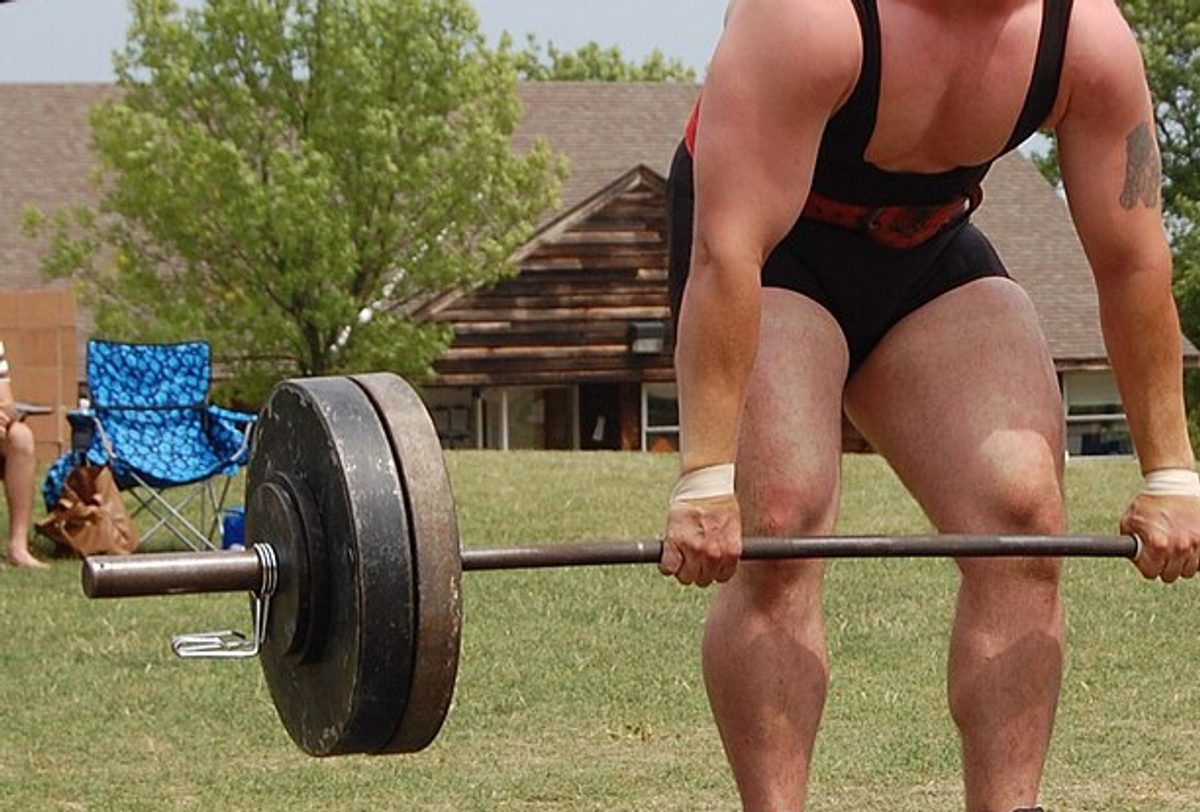
stu_spivack · CC BY-SA 2.0 (recadrée)
Lowering the bar slowly, adding weight on the way down, doing "nordics": does eccentric training really build more muscle? For strength, a bit more, especially braking strength. For muscle mass, not clearly more than traditional training. Where it does make a difference is on athletes' hamstrings, with evidence that is flimsier than claimed. Here is what twenty-two studies measure.
Eccentric, concentric: what are we talking about?
Every repetition has two phases. The concentric phase is when the muscle shortens to lift the load (you push the bar up). The eccentric phase is when it lengthens while braking the load (you lower it back down). We are stronger when braking than when lifting, and that is what eccentric training exploits: heavier loads on the way down, a slower descent, or machines that overload the braking phase.
For strength: an advantage, especially in braking
A meta-analysis of 20 randomized trials concludes that eccentric training, performed at a higher intensity, increases total strength and eccentric strength more than concentric training. Its authors explain this by the heavier loads the muscle supports while braking. A review of 40 studies in adults aged 17 to 35 points in the same direction, with an important nuance: the gain is often specific to the trained mode. You mainly get stronger in the movement you have trained.
A meta-analysis of 19 trials involving 618 people, either healthy or with a metabolic disease, finds significantly higher overall strength after eccentric training (standardized mean difference of 0.70), and blood pressure that drops. On the other hand, nothing on blood glucose.
In 28 men already strength-trained, adding a 40% load on the descent increased maximum isometric strength by 18%, compared to 1% with traditional training. However, muscle mass increased just as much in both groups. To calculate your loads based on your maximum, the 1RM calculator does the job.
For muscle: no real difference
This is the question everyone asks, and the answer is disappointing. The 2017 meta-analysis of 15 studies finds average growth of 10.0% with eccentric training versus 6.8% with concentric training, but the difference is not statistically significant. Its authors recommend keeping both phases in a program aimed at muscle growth.
Average gain in muscle size in %, meta-analysis of 15 studies (2017); non-significant difference
A more recent meta-analysis from 2025, covering 26 studies and 682 people, also finds no overall difference. Eccentric training only keeps the advantage in a few sub-groups: upper body muscles, programs of eight weeks or less, and when muscle is measured by thickness. The 2017 review sums it up as follows: eccentric training is "at least as effective" as other ways of training to grow muscle.
One result is surprising: in a trial of 24 beginners, it was fast eccentric training that built the most muscle and strength, not slow eccentric. And the meta-analysis on descent duration (9 studies, 166 people) does not allow a conclusion for strength or muscle; the only certainty is that a short descent improves the jump. Slowing down to the extreme is therefore not mandatory. The article sets, repetitions, or time under tension details what really matters for muscle.
Flywheel machines, which return the energy of the ascent to the descent, fare better: a meta-analysis of 9 studies on 276 people finds greater strength, power, muscle, jump height, and running speed than with traditional training.
The nordic exercise and the hamstrings
On your knees, ankles held, you let yourself fall forward while braking with the backs of your thighs: that is the nordic exercise. In a large randomized trial in Danish football, 50 teams and 942 players, ten weeks of nordics reduced acute hamstring injuries from 13.1 to 3.8 per 100 player-seasons, including new injuries and recurrences.
Injuries per 100 player-seasons, randomized trial on 942 players
A meta-analysis of 15 studies involving 8,459 athletes concludes that programs including the nordic exercise cut the risk by about half (relative risk of 0.49). Good news for motivation: a low volume of nordics increases eccentric strength just as much as a high volume (13 studies). Out of 17 studies, the gain in sprint is minimal (0.04 seconds) and strength progresses mainly in poorly trained players.
Injury prevention, less certain than announced
After 60: a little extra for strength
A 2026 meta-analysis on 11 randomized trials in older adults finds a slightly greater strength gain with eccentric training (standardized mean difference of 0.27), but no difference for power, muscle or daily living capabilities. A smaller meta-analysis (5 studies, 138 people) finds no significant difference for leg strength. Both methods work.
A trial in older adults clearly shows the "mode-specific" effect: eccentric training increased knee braking strength by 9 to 17% without affecting pushing strength, and traditional training did the reverse, with 22 to 37% more pushing strength. Fibers lengthened by 20% with eccentric training, versus 8%. In younger adults, another trial on 21 people does not find this gap: quadriceps fibers lengthened in both groups starting at five weeks (+6.3% in concentric, +3.1% in eccentric), then no longer at all up to ten weeks. For the rest, the article weight training after 60 details what we still gain.
The price to pay: muscle soreness
Eccentric training damages the muscle more at first. In a trial on 28 women, soreness was highest after eccentric and isometric training, and minimal after concentric training. After 70 maximal eccentric arm contractions, in 26 young women, pain, swelling, stiffness and strength loss peaked between 24 and 96 hours.
Did you know?
The muscle adapts quickly: a meta-analysis of 11 studies in 72 people finds no additional adaptation between a second and a third eccentric session, neither on strength loss nor on its recovery. To relieve the following days, the article muscle soreness: what really works? sorts things out.
What eccentric will not do
In summary
| Your question | What the studies say |
|---|---|
| More strength? | A little more, especially in braking, and especially in the trained movement |
| More muscle? | No significant difference with concentric training in two meta-analyses |
| Lowering very slowly? | Not necessary: the duration of the descent does not clearly change strength or muscle |
| Inertial flywheel? | Better than traditional training in a meta-analysis of 9 studies |
| Nordics and injuries? | From 13.1 to 3.8 injuries per 100 seasons in a large trial; evidence considered uncertain in the re-analysis |
| After 60? | A little extra for strength, nothing more for muscle or daily life |
| Soreness? | More than with concentric, and strength returns after the pain |
To fit a Nordic session or loaded descents into your week, the workout generator suggests a program, and the exercise library shows how to perform each movement.
A program tailored to your level and equipment, in a few clicks.
Build my workoutEvery figure in this article comes from a study you can open: the underlined mentions lead to the summary of the work it is taken from, written solely from the abstract. Informative content, which does not replace the advice of a healthcare professional: if you are resuming training after an injury or if you have tendinitis, ask a physiotherapist to guide you.