Unilateral or bilateral: one leg at a time, is it better?
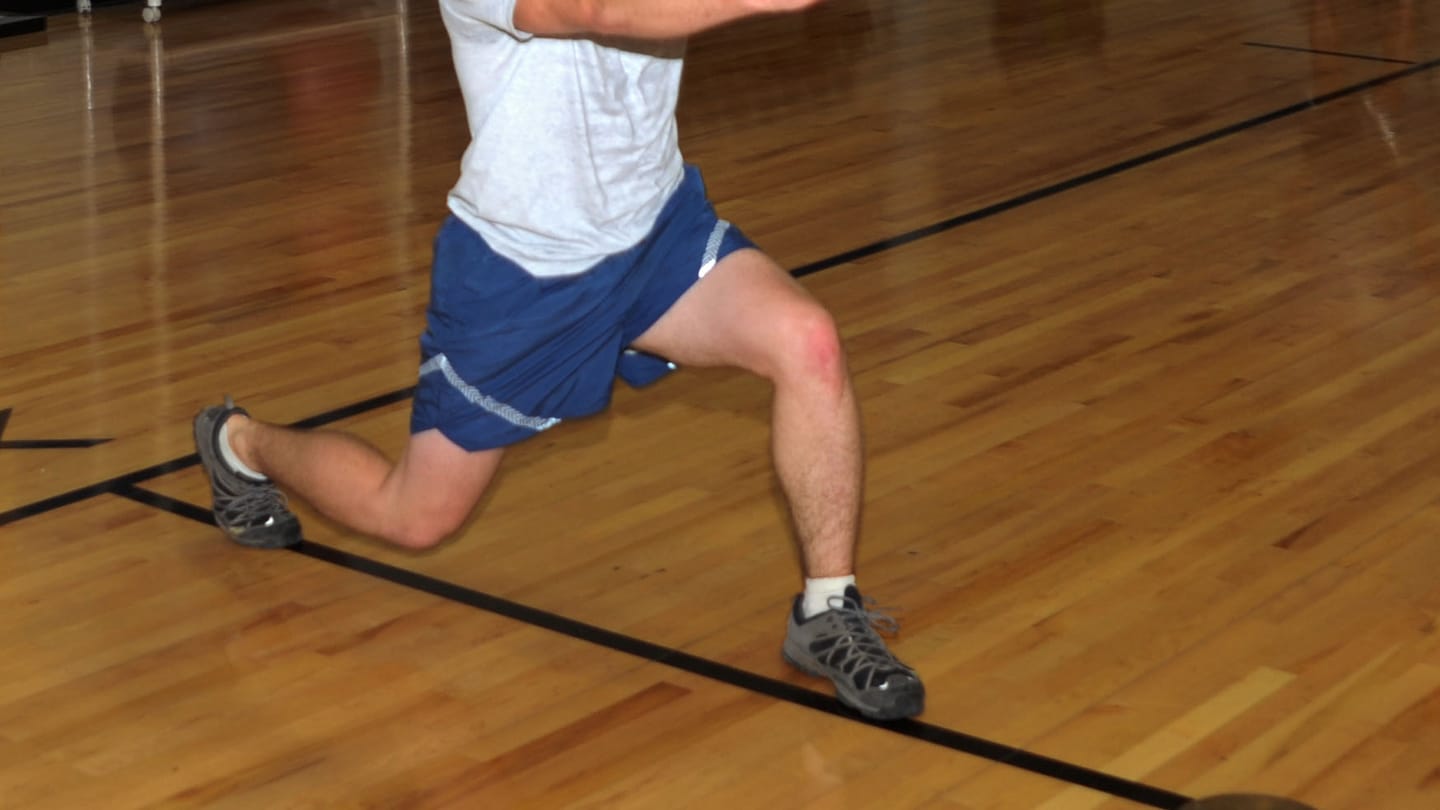
Senior Airman Myles Stepp, U.S. Air Force · Domaine public (recadrée)
Lunges and single-leg squats, or double-leg squats and leg presses: which one makes you progress more? For muscle, no difference. For strength, everyone wins on their own ground: you get stronger in the movement you practice. For jumping, sprinting, and changes of direction, the gap is slim to none. Here is what twenty-one studies measure.
Two legs together are not worth two legs one after the other
A unilateral exercise works one limb at a time (lunge, Bulgarian split squat, single-leg press, step-up); a bilateral exercise, both together (squat, double-leg press). Researchers are interested in a phenomenon called bilateral deficit: the strength of both legs pushing together is often lower than the sum of their strengths measured one by one. In twelve trained men, during leg extension, the maximum load (1RM) measured leg by leg reached 135 kg, compared to 120 kg with two legs.
This deficit is not seen everywhere. In postmenopausal women, it appeared on the leg press and lat pulldown, but not on leg extension. And training shifts it: in the same trial, training with two legs reduced it, training leg by leg barely changed it.
Did you know?
For muscle: a tie
A 2025 meta-analysis brings together 9 trials: no difference in hypertrophy between unilateral and bilateral (-0.21 effect size, non-significant). A 2026 meta-analysis, on 24 randomized trials, also finds no difference for muscle growth.
The trials all point in this direction. In 48 men and women aged 43 to 75, 12 weeks of leg extension made the quadriceps grow by 14% with two legs and 11% leg by leg, a non-significant gap. In the 43 young women, muscle thickness increased just as much in both groups. In postmenopausal women, only the unilateral group gained more lean leg mass than the control group, but with no difference compared to the bilateral group.
For strength: you progress in the movement you practice
The 2025 meta-analysis puts it in one sentence: strength gains follow the principle of specificity. Training with two legs improves two-leg strength more (effect size of 0.56); training leg by leg, single-leg strength (0.65). The 2026 one finds the same thing, with slightly smaller effects: 0.42 for single-leg strength in favor of unilateral, 0.28 for two-leg strength in favor of bilateral.
1996 trial, 48 men and women aged 43 to 75, leg extension
In 28 untrained young men, 8 weeks of leg press increased the maximum two-leg load equally in both groups (13.4% with two legs, 14.7% leg by leg), but the maximum single-leg load more in those who had trained that way (22.7% versus 13.7%). A 1997 trial on hands, arms, and legs speaks of lateral specificity: everyone progresses mostly in the condition they trained.
Strength still transfers from one movement to another. In 33 rugby players, 8 weeks of squatting or step-ups improved the trained exercise (effect sizes of 0.67 and 0.74) and also the one that was not. In 38 untrained men and women, both methods improved leg strength and power equally, except for the single-leg jump, which was better after unilateral training. And in 31 trained young men, isometric squat strength increased comparably (17.4% with two legs, 11.4% leg by leg).
2026 trial, 28 untrained young men
Jump, sprint, changes of direction
This is the "closer to the field" argument: you run and change direction on one leg at a time. A 2022 meta-analysis proves unilateral training right for the single-leg jump, with a large effect (0.89), but finds no difference for speed, changes of direction, or the two-footed jump. The 2026 one confirms: an advantage for the single-leg jump (0.35), nothing for the sprint or changes of direction.
In 355 team sport athletes, no overall difference between the two methods; unilateral wins out for single-leg strength (0.68) and the single-leg jump, and, in basketball only, for sprint and agility. In 415 male athletes, unilateral only does better on a 5-meter sprint and on changes of direction to the left, results that the authors consider selective and of small magnitude. For forward-oriented movements, both are effective (effects of 0.60 and 0.57) with no difference between them. The same observation applies to plyometrics, where a 2025 meta-analysis finds each type of jump better for the jump that resembles it.
In 18 young rugby players, 5 weeks of Bulgarian split squats or back squats improved the 1RM in both exercises, the 40 m sprint, and agility just as much.
Lunges do not necessarily fix your imbalances
With age
The 1996 trial involved people aged 43 to 75: both methods gained strength and muscle, with the strength gap once again following the exercise practiced. In older adults, another comparison: heavy two-legged training versus balance training mostly made of single-leg exercises. Both increased single- and two-legged strength and reduced the bilateral deficit, but heavy training did significantly better, almost approaching the values of young adults. The article strength training after 60 details what else is gained from it.
The limits, nevertheless
In summary
| Your question | What the studies say |
|---|---|
| Does one leg at a time build more muscle? | No: no difference in meta-analysis (9 and 24 trials) |
| And more strength? | In the practiced gesture: two legs for the squat, one leg for the lunge |
| To jump on one leg? | Advantage to unilateral (effect of 0.35 to 0.89) |
| For the sprint and changes of direction? | Almost no difference; one trial gives the advantage to the squat |
| To correct an imbalance? | Contradictory results: one trial for unilateral, another for bilateral |
In practice: choose according to your goal. To lift heavier on the squat, train the squat; for a sport where you jump and push off one leg, keep a place for lunges and their variants; for muscle, take what you do with pleasure and consistency. The workout generator offers you both exercise families, the exercise library shows them to you, and the 1RM calculator helps you set your loads. Free weights or machines? The article free weights or machines takes stock, and the one on periodisation does too for how to vary.
Lunges, squat, leg press: put together a training session that fits your goal.
Generate my sessionEvery figure in this article comes from a study you can open: the underlined mentions lead to the summary of the work it is drawn from, written from the abstract alone. The trials are short, focusing mostly on legs and young athletes. Informational content, which does not replace the advice of a health professional.