Execution speed: lift slowly or fast?
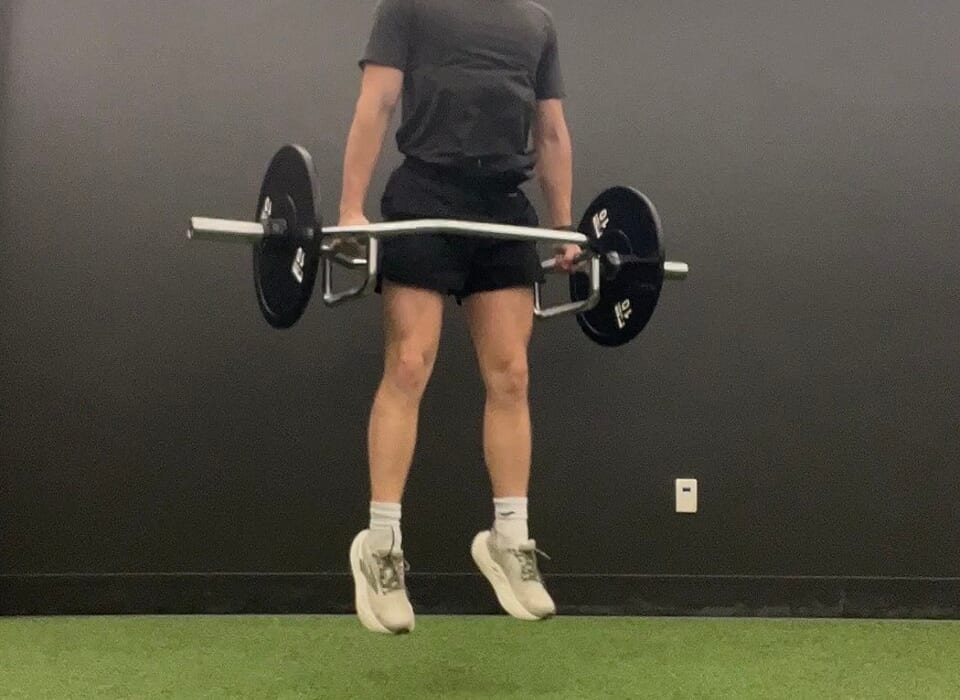
RickyBennison · CC BY-SA 4.0 (recadrée)
Should you lower and raise the barbell slowly, or push as fast as possible? For strength and explosive power, pushing fast works at least as well as slowing down, and sometimes better. For muscle growth, tempo matters little, as long as you do not fall into extreme slowness. After the age of 60, lifting fast helps a bit in daily life, provided you keep a sufficient load. Here is what twenty-two studies measure.
What we are talking about
Execution speed is the time you take to perform a repetition: the concentric phase (lifting), the eccentric phase (lowering), and the pauses. We call it "tempo" when it is set in advance, for example two seconds to lower and one to lift. In the trials that follow, "fast" often means pushing with the intention of moving as fast as possible on every lift.
For strength: pushing fast, at least in intention
A meta-analysis of 15 studies compares fast and slow training at equal load and volume. Overall, both increase strength just as much as each other, regardless of age and level. But at a moderate load, between 60 and 79% of the maximum, a trend emerges in favor of fast (effect size of 0.31, borderline significant).
A trial in 21 trained young men isolates speed alone: the same full squat program for six weeks, but one group pushes at maximal speed and the other voluntarily at half that speed. The fast group gains more in maximal strength and jump height, and each group improves the most at the speed it trained at. According to the authors, speed matters more than time under tension to gain strength. On the 20-meter sprint, however, the effect is not clear.
Effect size on maximal strength, 21 trained men, 6 weeks
To find out which load corresponds to 60 or 80% of your maximum, the 1RM calculator does the math based on a single set.
"Superslow": less strength in beginners
The "superslow" method stretches each phase to 10 seconds. In 14 sedentary women followed for ten weeks, both methods increased strength across all eight machines, but the conventional speed group gained much more: 39% on total weight lifted, compared to 15% in superslow. Neither body composition nor aerobic capacity changed differently.
Strength gain in %, 14 sedentary women, 10 weeks
Over four weeks, in 35 female students, percentage gains were similar between superslow and the conventional method, but only the conventional group clearly stood out from the control group, as superslow results varied so much from one person to another. And in a six-week trial on 34 untrained women, a 10-second lift enlarged certain muscle fibers, but normal speed with a heavy load (80 to 85% of maximum) provided the most complete response.
For muscle: tempo matters little
A meta-analysis of eight studies, all carried out to muscular failure, finds similar growth for repetitions lasting 0.5 to 8 seconds. Beyond 10 seconds per repetition, it would be less effective, but too few controlled studies allow this to be stated. A review of six studies on 119 beginners goes both ways: the quadriceps grew more with a moderate to slow tempo in three studies, the biceps more with a fast tempo in two. Too little data to decide.
The explanation may lie in a trial on ten men: when the set goes to failure, all muscle fibers work, whether the load is heavy or light, the repetition short or long. The article sets, repetitions, or time under tension details why the stopwatch does not predict muscle gain.
Slow and light: a gateway
Slowness has a purpose: making the muscle work with a light load. In 24 young men, leg extensions at about 50% of the maximum, taking 3 seconds on the way down and 3 on the way up without ever releasing, made the muscle grow and gained strength in twelve weeks, like a heavy load at normal speed. The same light load at normal speed yielded nothing significant.
In 18 adults aged 60 to 77, even at 30% of the maximum, the slow and continuous version increased the quadriceps cross-sectional area by 5.0% in twelve weeks, versus 1.1% (not significant) for the same load in fast movements interspersed with pauses. Strength, on the other hand, increased in both groups. And a randomized trial in 88 people aged 70 and over, using body weight (squats, wall push-ups, trunk raises, 4 seconds per phase), thickened the thigh muscle, increased leg strength, and reduced waist circumference compared to the control group.
Regarding mechanism, a trial on eight men at 30% of the maximum shows that 6-second repetitions prolong muscle protein synthesis: stronger 24 to 30 hours after the training session than with 1-second repetitions, for equal work.
Stop when the bar slows down
Over the course of a set, the bar goes up less and less quickly. Some train by measuring this speed and stop the set as soon as it has lost a set percentage. In a trial on 22 young men, eight weeks of squatting, stopping at 20% velocity loss gave the same strength gain as stopping at 40%, and more jump height (9.5% versus 3.5%). Stopping later made two thigh muscles grow slightly more, the vastus lateralis and the vastus intermedius.
Did you know?
A meta-analysis of 19 training studies confirms this: the stopping threshold changes neither strength nor muscular endurance. A high threshold slightly favors muscle, a low threshold favors jumping, sprinting, and speed under a light load.
Does setting loads based on speed rather than a percentage of the maximum work better? The results diverge. A trial in 16 trained men finds more progress in the bench press (8% versus 4%) and in jumping, with less total volume. But a meta-analysis of four trials on 88 people finds no difference for strength, power, or sprinting, with evidence rated as low quality.
After 60: fast on the way up, but heavy enough
Power training means lifting the load as fast as possible and lowering it under control. A meta-analysis of 20 randomized trials on 566 healthy people, averaging 70 years old, finds a small advantage for it on everyday physical capabilities compared to traditional training (standardized difference of 0.30), with low-certainty evidence. An older meta-analysis, 11 trials and 377 people, reached the same small advantage (0.32), without being able to conclude on safety.
In 38 older adults, lifting fast at 40% of maximum or slowly at 80% improved power and maximum strength equally in twelve weeks; the fast version mainly improved speed under a light load.
Fast, but not too light
Explosive on the way up, controlled on the way down
In summary
| Your question | What the studies say |
|---|---|
| Push fast for strength? | At least as good as slow, slightly better at medium load |
| Super-slow (10 seconds per phase)? | Less strength in beginners: 15% versus 39% in ten weeks |
| Does tempo change the muscle? | Not between 0.5 and 8 seconds per repetition, up to failure |
| Slow and light, does it work? | Yes for muscle, including after 60, if you never let up |
| Stop when the bar slows down? | Same strength with fewer repetitions, slightly less muscle |
| After 60? | Lifting fast helps a bit in daily life, provided you keep enough load |
| And the descent? | Under control: fast, it damages the muscle more |
To integrate these benchmarks into your week, the workout generator offers you a program, and the exercise library shows how to perform each movement.
A program tailored to your level and equipment, in a few clicks.
Build my workoutEvery figure in this article comes from a study you can open: the underlined mentions lead to the summary of the work it is taken from, written solely from the abstract. A 2021 review recalls that no study has yet measured over time the effect of each phase taken separately. Informative content, which does not replace the advice of a healthcare professional: after 60 or with a health problem, get guidance to start.