Foam roller: flexibility, strength and recovery
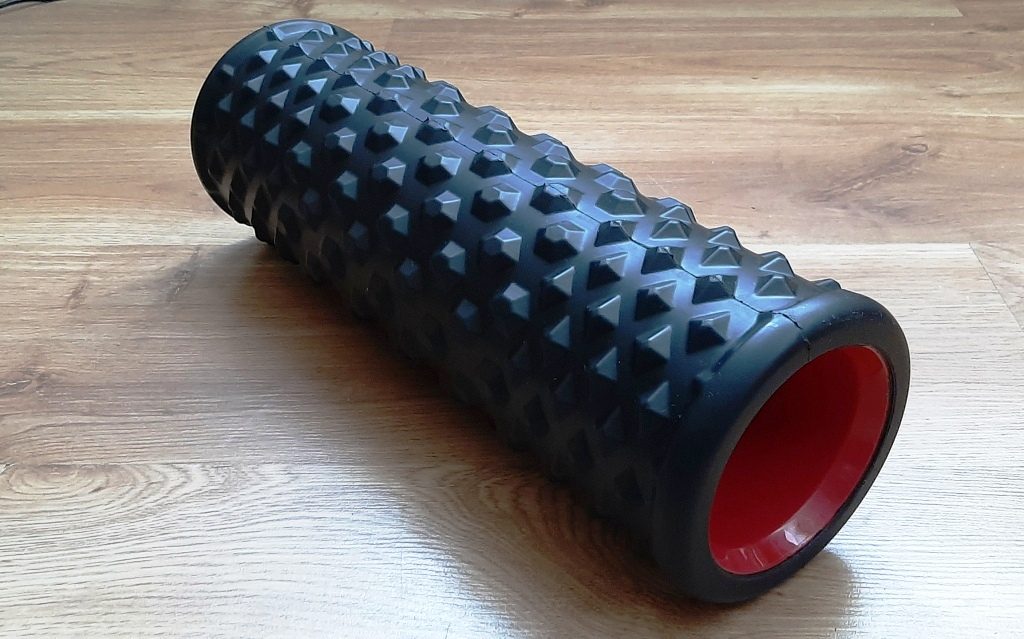
Aleksander Durkiewicz · CC BY-SA 4.0
Does the foam roller actually do anything? Yes, but very little: it temporarily increases flexibility without sacrificing strength, and slightly reduces muscle soreness. It performs no better than ordinary stretching or warm-ups, and several weeks of rolling make you neither stronger nor faster. Here is what twenty-two studies measure.
Flexibility: a real gain, but no better than stretching
This is the most well-established effect. A 2020 meta-analysis finds a significant effect of the roller on range of motion compared to no exercise, but no advantage over stretching. Another meta-analysis quantifies the effect on range of motion at d = 0.76, a large effect, and concludes that apart from flexibility, it cannot be said that the roller directly improves performance.
This gain does not last. In a 2021 trial, 3 or 10 sets of 30 seconds of rolling increased ankle dorsiflexion (effect sizes of 0.26 and 0.33), but the range of motion had returned to baseline 30 minutes later, and neither muscle stiffness nor strength had changed. And if you compare it to any other warm-up, a 2024 meta-analysis sees no difference, neither for range of motion (effect size of 0.01) nor for stiffness (0.09): the roller and stretching are not essential to feel more flexible before your training session.
Duration matters. In 33 students, 2 sets of 10 seconds or 4 sets of 30 seconds on the hamstrings were not enough to increase knee extension. A review aimed at coaches puts the right duration at 90 to 120 seconds of total rolling per muscle, in addition to dynamic stretching and an active warm-up. Stretching itself has its own article: does stretching make a muscle grow?
Did you know?
Before the training session: neither strength gain nor loss
Before exertion, the roller does not appear to weaken the muscle. The 2019 meta-analysis finds, during the warm-up, a small gain in sprint (+0.7%) and flexibility (+4.0%), and negligible effects on jump and strength. A 2023 meta-analysis sees no effect on isometric strength, eccentric strength, or rate of force development; only the concentric strength of the knee extensors increased. In 26 young adults, the roller did no better than core stability exercises across four tests (jump height and power, strength, agility), but participants felt less fatigued afterwards.
Compared to stretching, a 2021 meta-analysis finds no overall difference in performance, with a trend favoring the roller. The advantage becomes clear compared to static stretching, when rolling lasts more than 60 seconds, or when it vibrates; compared to dynamic stretching, the two are equal. And if you do both, the order matters: a 2021 meta-analysis sees no greater flexibility with both than with either alone, but a small advantage for performance when the roller comes before stretching, not the other way around.
Between sets: it costs you reps
2017 trial, 25 women, knee extensions
In this trial on 25 women, the roller was used on the quadriceps during the rest between sets of knee extensions pushed to muscular failure. The longer the rolling lasted, the fewer reps they performed: with passive rest, they completed 13.8% more than with 120 seconds of rolling. The authors consider rolling between sets unfavorable to the capacity to produce force from one set to the next. To properly gauge these rest periods, see rest time between sets.
Rolling during the training session: bad idea
After the training session: slightly less muscle soreness
This is its second use. The 2019 meta-analysis finds that after exertion, the roller slightly mitigates the drop in sprint performance (+3.1%) and strength (+3.9%), and reduces perceived muscle pain (+6.0%); its authors consider these effects rather minor and view it more as a warm-up tool than a recovery tool. A review aimed at coaches notes that it reduces muscle soreness and increases the pressure pain threshold.
Individual trials go further. In 20 strength-trained men, post-workout rolling after a muscle-damaging session markedly reduced pain and improved range of motion across all measurements, and jump height at 48 hours. In 8 active men, it improved quadriceps sensitivity in the following days (effect sizes from 0.59 to 0.84) and limited losses in sprint and power performance. In 18 professional soccer players, 20 minutes of rolling right after training improved agility (effect size of 1.06), perceived recovery (1.08), and muscle soreness (1.02) 24 hours later compared to passive rest. Other recovery methods are compared in the article muscle soreness: what to do?, and cold therapy in the cold bath after the training session.
Several weeks of rolling: no greater performance
Used regularly, the roller increases flexibility slightly: a 2022 meta-analysis finds a moderate effect on range of motion, greater beyond 4 weeks, for the hamstrings and quadriceps, but not for the ankle. For performance, on the other hand, another 2022 meta-analysis finds no difference compared to control groups after more than two weeks, regardless of age, duration, or amount of rolling. A review of trials lasting at least four weeks finds contradictory results for flexibility and, in most trials, no benefit for performance. In 23 active students, 3 or 6 training sessions per week for 4 weeks changed neither range of motion, nor pain sensitivity, nor strength, nor jumping ability, with one exception (+6.2% jump performance on the non-dominant leg in the 3-session group).
And what about the vibrating roller?
For flexibility, it does a bit better: a 2021 meta-analysis finds an advantage over the standard roller (standardized mean difference of 0.53), especially at the hips (0.56) and knees (0.86). The 2020 meta-analysis, however, sees no difference when pooling the studies. For performance, a 2022 meta-analysis finds no significant effect on jump (0.14) or isokinetic strength (0.16), nor on agility; recovery seems better, and the authors call for further studies.
The limitations, all the same
In summary
| Your question | What the studies say |
|---|---|
| Does the roller increase flexibility? | Yes, clearly, but no more than stretching, and the effect fades away in half an hour |
| How long? | About 90 to 120 seconds per muscle; 2 minutes at most may not be enough |
| Does it cause a loss of strength before the training session? | No, and it doesn't make you gain any either |
| Between the sets? | To be avoided: up to 13.8% fewer reps |
| After the training session? | Slightly less muscle soreness and slightly better preserved performance |
| Several weeks of rolling? | A little more flexibility, no more performance |
| Vibrating roller? | A little more flexibility, nothing proven for performance |
In practice: if you like the roller, keep it for the warm-up (one to two minutes per muscle, before your dynamic stretches and your active warm-up) or for after the training session; leave it aside during the rest periods. For the rest of your week, the training session generator builds you a program.
Build your training week, and place the roller in the warm-up or after the training session, not between the sets.
Generate my training sessionEvery figure in this article comes from a study that you can open: the underlined mentions lead to the summary of the work it is taken from, written solely from the abstract. The trials are small and often limited to a single training session, in young and healthy adults. Informative content, which does not replace the advice of a healthcare professional.