The cold bath after the training session: what it relieves, and what it costs
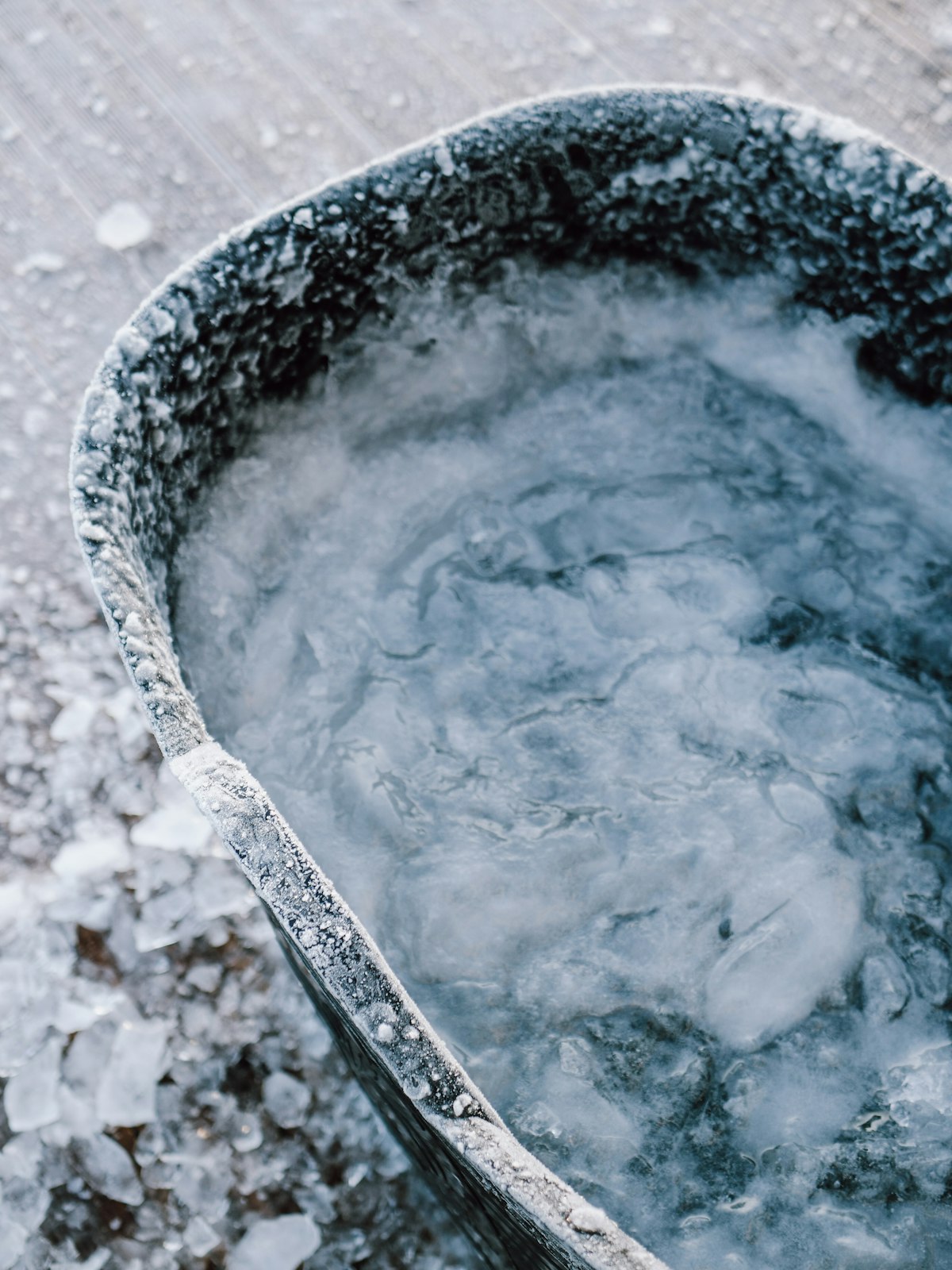
The ice bath has become a ritual: you leave the gym, you immerse yourself, you feel like you've done something extra. Studies say you've actually done something — and that it's not necessarily what you think. The cold really relieves pain, that's measured. It also slows down muscle growth, and that's measured too. Both are true at the same time, which makes the question interesting.
Twelve weeks, two groups, only one that progresses
The study that launched the debate is a 2015 trial published in the Journal of Physiology. Men train for strength for twelve weeks. After each training session, half spend ten minutes in cold water, the other does active recovery. Same program, same duration, a single difference.
In the end, strength and muscle mass progressed more in the active recovery group. And when you look at the muscle itself rather than the scale, the gap becomes clear: the cross-sectional area of type II fibers increased by 17% and the number of nuclei per fiber by 26% — in the active group only. The cold bath also reduced the influx of satellite cells, those that repair and grow the fiber, and post-training anabolic signaling.
The sentence that sparked discussion
A second trial, in 2019, brings the nuance that was missing. Seven weeks, sixteen hommes, same setup. This time the gains in strength at 1-RM are identical in both groups — but the increase in the cross-sectional area of type II fibers is, once again, slowed down by the cold. On the mechanism side, post-training anabolic signaling was reduced and protein degradation markers increased.
In other words: what takes the hit first is the size of the muscle, not necessarily its strength. The two do not progress through the same pathways, and the cold seems to affect one more than the other. A 2021 review dedicated to this mechanism arrives at the same reading: the cold indeed accelerates recovery in the short term, and it attenuates anabolic signaling and muscle protein synthesis — which is enough to explain the missing gains after several weeks.
What the synthesis of all these trials says
A 2021 meta-analysis gathered the eight works that measured the effect of the regular cold bath on training adaptations. The result is consistent with the two trials above, and it cleanly separates the two disciplines:
| What was measured | Effect of regular cold bath |
|---|---|
| Maximal strength, isometric strength, muscular endurance | Deleterious effect — effect size −0.60 |
| Ballistic performances (jump, explosiveness) | Deleterious effect — effect size −0.61 |
| Aerobic endurance (time trial, maximal power) | No significant effect |
A 2014 trial tested the thing as cleanly as possible: in seventeen trained men, one leg received the cold bath, the other did not, in the same person. Strength went up on both sides, but the trend always went towards the uncooled leg — 1.6% then 2.0% difference on the 1-RM. It's little. Repeated for years, it's nothing anymore.
An older work, from 2006, had already pointed in the same direction with a striking image: over four to six weeks, the significant effects of training were three times more frequent in the uncooled limb than in the cooled limb.
So why does everyone do it?
Because it works — on something else. A Cochrane review brought together 17 trials and 366 participants on the single question of DOMS. The cold reduces them at all measured timepoints, and the effect is most marked at 72 hours. Participants also felt less fatigued right after immersion.
Cochrane Review, 17 trials, 366 participants
And it's not just about how you feel. A trial on twenty men after prolonged intermittent running measured the loss of voluntary knee flexor strength. It was significantly lower with cold: 12% compared to 21% at 24 hours, and 3% compared to 14% at 48 hours. On a tight schedule, that difference matters.
The largest meta-analysis on recovery, grouping 68 studies, paints a clearer picture, and it's less simple than you'd think. Cold helps endurance recovery within the hour, but impairs sprinting at one hour and jumping at six hours — a cooled muscle is a less snappy muscle. On the other hand, it promotes jump recovery at 24 and 96 hours, and strength recovery at 24 hours.
The detail that changes everything: when you go again
In endurance, cold isn't the enemy — perhaps quite the opposite
This is the least known part. A 2017 trial followed six weeks of sprint interval training with or without cold water immersion: neither endurance signaling pathways, nor maximal aerobic power, nor VO₂ max, nor the 2 km time trial were affected. Neither beneficial, nor harmful.
A 2015 study goes further. Four weeks of endurance training, one leg cooled after each training session, the other not: regular cooling increased AMPK, p38, and PGC-1α — the markers for new mitochondria production. Participants improved their VO₂ max by 5.9% and their running speed by 6.2%.
A 2021 review summarizes this dual life of cold in an honest title: "friend, foe, or useless?". Its answer is that it depends on what you're training — bodybuilding adaptations are diminished, endurance adaptations are not and might even be helped — and that you therefore need to periodize: cold during competitions and heavy training blocks, not during blocks dedicated to strength and mass.
What doesn't work the way people say
The explanation you hear everywhere — "cold lowers inflammation" — didn't hold up when tested head-to-head. A 2017 trial compared cold water immersion and active recovery after a bodybuilding session, with biopsies to prove it: no difference on inflammatory cell infiltration, cytokines, or heat shock proteins. Cold was no more effective than a simple low-intensity stationary bike.
A review of mechanisms offers a more down-to-earth explanation: what cold really does is lower core temperature, reduce central fatigue and cardiovascular strain, and reactivate the parasympathetic system. You feel better because you're less hot and cool down faster, not because you've "cleansed" anything. Another review lists what cold actually alters in the tissue: local temperature, blood flow, cell swelling, metabolism, and nerve conduction velocity — enough to change a lot of sensations, and very little of the repair work.
There is even a signal in the opposite direction. Work from 2017 compared cooling and warming the muscle post-exercise: contractile function recovery was accelerated by heat and slowed by cold, with glycogen resynthesis being faster at elevated temperatures. And an older trial in fifteen women had already found a mixed result — creatine kinase drops, stiffness improves, but perceived soreness and strength loss do not budge.
If you do it anyway: the dose that was tested
A systematic review of nine studies looked for the temperature and duration that yield the best result on delayed onset muscle soreness. It converges towards 10 to 15 °C for 10 to 15 minutes, with a dose-response relationship. Colder is not better: a trial on sixty men comparing 9 °C and 14 °C saw the fastest strength recovery at 14 °C, not 9.
| Your goal | What these studies say |
|---|---|
| Building muscle | Avoid the cold bath after training sessions — that's where the loss is measured |
| Gaining pure strength | The effect is less clear: one trial finds no 1-RM loss, the meta-analysis does |
| Back-to-back training sessions or a tournament | Cold helps, unless you need to be explosive within the following hour |
| Progress in endurance | No measured loss, and one trial even shows more mitochondria |
| Hurting less tomorrow | It works, with maximum effect around 72 hours |
In nine trained runners, whole-body cryotherapy made it possible to recover strength and sensations as early as the first session, one hour after exertion, whereas passive recovery failed to do so at all. It is the same logic: when the deadline is near, cold is a tool. When the goal is to build, it works against you.
This story bears a strong resemblance to that of anti-inflammatories taken for muscle soreness, which we recount in our article on what really works against soreness: the product does what it is asked regarding pain, and pays elsewhere.
A block dedicated to mass and a block dedicated to competition are not recovered from in the same way. One still needs to know which one they are in.
Track my training sessionsEvery figure in this article comes from a study you can open: the underlined mentions lead directly to the summary of the work from which the figure is drawn. These summaries were written based on the abstract alone. The cited trials involve small sample sizes, often young and trained men, over a few weeks — which is not the same thing as an entire career. Informative content, which does not replace the advice of a professional.