Compression garments: do you really recover faster?
By Kalorya · November 11, 2026 · 7 min read
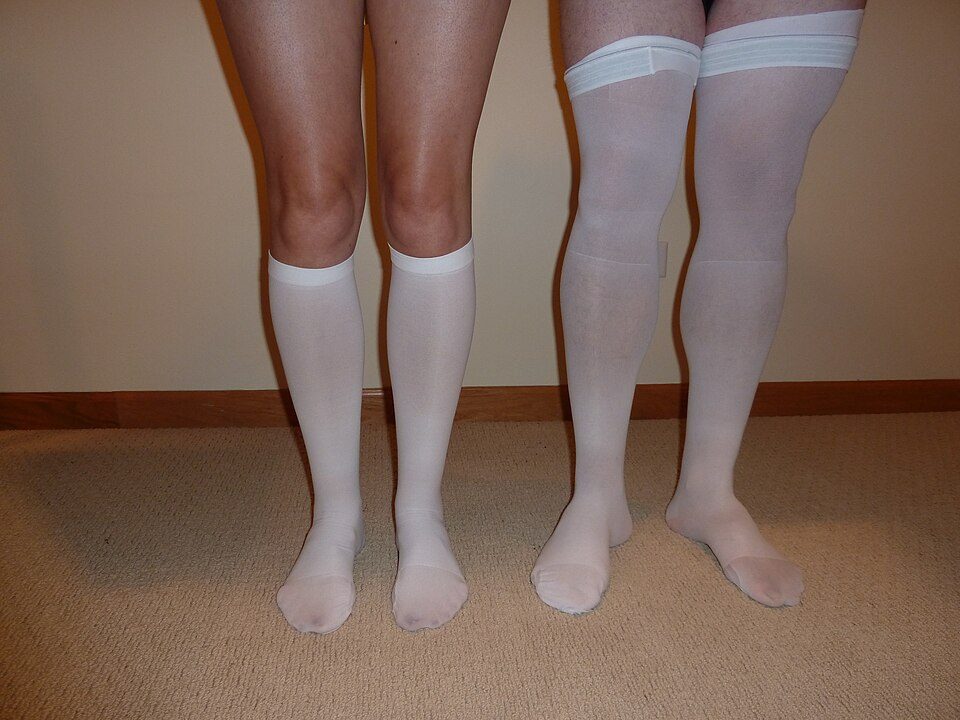
Lentpjuve · CC BY-SA 4.0
Tights, socks, compression sleeves: do you really recover faster with them? After a training session that damages the muscle, slightly: strength and jumping ability return a little faster and muscle soreness is slightly less severe, according to several meta-analyses, but the strictest one finds nothing regarding strength. During running, on the other hand, they gain you neither time nor endurance. Here is what twenty-two studies say.
Post-training session: what meta-analyses find
The first major synthesis, across 12 studies, finds a moderate effect of the garment worn after an effort that damages the muscle: less soreness, strength and power that return faster, and less creatine kinase in the blood, an enzyme that signals muscle damage. A second one, across 23 studies, speaks of small but very likely benefits, the clearest ones for strength, between 2 and 8 hours then beyond 24 hours, and especially after a weight training session. A third one finds less muscle swelling, less perceived pain and a strength that returns faster, but no effect on creatine kinase (9 studies).
Not everyone agrees. The 2022 meta-analysis, limited to randomized trials (19 trials, 350 participants), finds no effect on strength recovery, whether the measurement is taken immediately or more than 96 hours after, regardless of the covered area; only a small effect after jumps. Its authors advise coaches to reconsider the use of compression garments for this purpose. The most recent one, across 27 studies, finds an effect, but a small one (g = 0.21 for strength, 0.23 for power), slightly clearer in trained athletes.
A small effect, not a miracle
The trials, one by one
In 17 active young women, compression stockings worn 12 hours after a series of plyometric jumps limited the decline in jump height and thigh strength, and muscle soreness (2.4 versus 4.0), without changing creatine kinase.
Trial, 17 active young women (2010); compression stockings 12 hours after effort
After weight training, the results point in the same direction. In 9 trained men, a garment worn for 24 hours brought back bench press strength faster (between 3 and 8 hours) and thigh strength (at 24 hours), with less soreness, but nothing in the blood tests. In trained men and women, a full-body outfit worn for 24 hours, after a heavy training session, reduced soreness, muscle swelling and creatine kinase, and improved barbell throw and jump power. In 19 handball players, tights worn over 96 hours limited the loss of strength (155 N less) and jump height.
Pressure may matter. In 45 active participants after 100 drop jumps, only the tightest garment, worn for 72 hours, better restored strength and jumping ability; soreness and blood markers did not change. After running too, in 18 men, 24 hours of compression improved the next-day jump, without changing soreness or blood tests. And in 10 inactive adults, compression socks after a maximal exercise test made soreness and stiffness 34.6 to 42.3% lower at 24 hours, 40.3 to 61.4% at 48 hours.
Did you know?
During running: nothing to gain
This is where the promise falls apart. A 2025 meta-analysis (51 studies, 899 participants) finds no improvement in running time or time to exhaustion; the only difference is that the muscle vibrates less. Another one, across 28 trials, concludes that compression socks during running do not perform better than regular socks, neither on the heart, nor on speed, nor on perceived effort, nor on soreness. Across 23 intense effort studies, nothing either, from 50 m to beyond 5,000 m, neither on jump nor on VO2max.
Isolated trials confirm this. In 15 well-trained endurance athletes, neither socks, nor tights, nor a full body suit changed oxygen consumption or time to exhaustion. In 11 runners running a 400 m, the chrono remained the same; the effort only seemed a little less hard. And in 20 marathon runners, socks worn during the race did not reduce creatine kinase, neither at the finish nor the next day.
Not an accelerator
And after a marathon?
One trial stands out. In 33 marathon runners, compression socks worn for 48 hours after the race improved treadmill run time two weeks later by 2.6% (52 seconds), whereas it dropped by 3.4% (62 seconds) with placebo socks. A single trial, but it points in the same direction as the 2017 meta-analysis: worn after the effort, and not during.
In practice
If you have a training session that heavily damages the muscle (a lot of jumps, downhill running, heavy loads) and another one shortly after, wearing compression tights or socks for 24 hours to 72 hours, even at night, can help you recover your strength a little bit. If you use them, choose them very tight: in one trial, only high pressure worked. For the rest of recovery, compare with the cold bath, the foam roller and above all sleep, and read what works against delayed onset muscle soreness. And the simplest way remains to space out your heavy training sessions: the training session generator helps you schedule them.
Summary
| Your question | What studies say |
|---|---|
| Do you recover faster after weight training? | A little bit: strength and jump performance return faster in several trials; the strictest meta-analysis finds nothing regarding strength |
| Less muscle soreness? | A little bit, according to several trials and meta-analyses, but very uncertain in endurance athletes |
| Run faster or longer with them? | No: nothing across 51 studies |
| Compression socks during the run? | No better than ordinary socks (28 trials) |
| Tight or not? | Only the tightest garment worked in a trial of 45 people |
| Keep them on at night? | Possible: slightly more strength the next day, unchanged sleep |
Before investing in tights, make sure your heavy training sessions are spaced out enough with the training session generator.
Rest between two heavy training sessions matters more than what you wear: plan your training week.
Generate my training sessionEvery figure in this article comes from a study you can open: the underlined mentions lead to the summary of the work it is drawn from, written based on the abstract alone. Informative content, which does not replace the advice of a healthcare professional.