BCAAs: myth or reality?
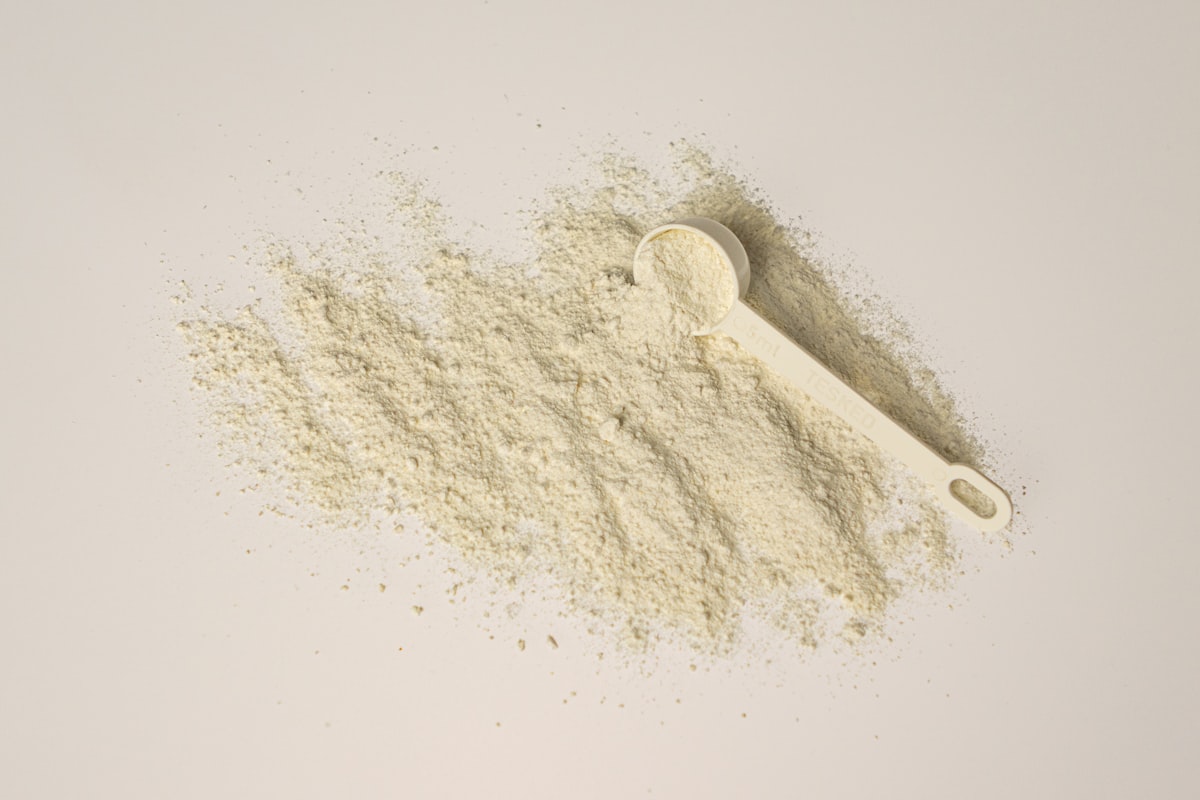
BCAAs — leucine, isoleucine, and valine — occupy an entire shelf in every sports nutrition shop, often at a high price. The promise: build muscle and protect the one you have. A 2017 scientific review asks the question in its very title: myth or reality? Its answer is harsh. But the story doesn't stop there — BCAAs do indeed do something, just not what you're sold.
The study that puts BCAAs against a real protein
This is the most telling comparison. In 2019, a double-blind, randomized trial divided 45 men aged 71 into three groups: 6 g of BCAAs, 6 g of branched-chain ketoacids, or 30 g of milk protein. Then muscle protein synthesis was measured, not once, but over two successive windows.
| What was taken | Early phase (0-2 h) | Late phase (2-5 h) |
|---|---|---|
| 6 g of BCAAs | Synthesis doubles: from 0.022 %/h to 0.044 %/h | Synthesis returns to its baseline level |
| 30 g of milk protein | Increase as well | Still high: 0.039 %/h |
BCAAs therefore work, strictly speaking: they do indeed increase protein synthesis. But it is a flash in the pan. Two hours later, everything has dropped back down, while the complete protein is still holding strong. The authors put it clearly: the increase achieved with 6 g of BCAAs is short-lived, unlike an equivalent amount of intact milk protein. The mechanism itself is very real: a 2006 study shows that BCAAs activate key synthesis enzymes after exercise — mTOR, p70 S6 kinase, S6.
Why it drops back down
The harshest verdict
The 2017 review goes further than "less effective". It first notes a void: upon its publication, no study had quantified the muscle protein synthesis response to BCAAs taken alone orally in humans. All commercial promise was therefore based on experimental emptiness.
And the only two studies that had tested BCAAs alone, intravenously, found that they decreased muscle protein synthesis — at the same time as they decreased degradation. The authors' conclusion is unambiguous: presenting BCAAs as a stimulator of muscle protein synthesis in humans is not justified.
A 2019 biochemical review is slightly less categorical: it qualifies the evidence as equivocal rather than absent. On this specific point, the literature is therefore not unanimous — but no one defends a solid effect.
And leucine alone?
This is the fallback argument: leucine is supposedly the "trigger" amino acid. There is some truth to the short term. A 2006 study in 20 men aged 70 added leucine to balanced meals and measured muscle protein synthesis over 5 hours.
2006 study in 20 men aged 70, measured over 5 hours. The error bar displayed on each column corresponds to the standard error.
The gap is clear. Except that three years later, the same question was asked over time: 30 healthy older men took 7.5 g of leucine daily for three months. Result: no change in muscle mass or strength, neither in the leucine group nor in the placebo group.
This is exactly the trap of this store aisle: a real acute effect, measurable in the laboratory over a few hours, which translates to nothing at all on the body after several months.
Nuance: leucine mostly seems useful for correcting an insufficient meal. A 2006 study shows that enriching an essential amino acid mixture with 41% leucine restores the response in the elderly, whereas 26% is not enough — but this enrichment provides no additional benefit in young subjects. And when the protein quantity is already sufficient, adding leucine does not increase muscle synthesis any further.
Where BCAAs actually do something
Let's give credit where it's due. In two areas that have nothing to do with muscle building, studies do find an effect.
Soreness and muscle damage. A 2021 meta-analysis covering nine randomized trials in trained men finds a positive effect on creatine kinase (a marker of muscle damage) at less than 24 h, at 24 h, and at 48 h after exercise. On soreness itself, the effect only appears within the first 24 hours, and another marker, lactate dehydrogenase, does not budge.
Mental fatigue in endurance. Several works, including one from 1991 conducted during a 30 km cross-country skiing race and a marathon, report an improvement in mental performance after exercise, and a reduction in perceived exertion during exercise. The hypothesis put forward is an action on the brain — less tryptophan absorbed, therefore less serotonin produced.
To be put into perspective anyway
One last case deserves to be mentioned, because it shows where BCAAs are truly useful: in patients suffering from alcoholic cirrhosis, a leucine-enriched mixture did not increase muscle synthesis, but it reduced the degradation of body proteins and corrected the mTOR signaling altered by the disease. This is a clinical use, in people whose muscle is wasting away — not an argument for the lifter who eats enough.
In summary
| Question | What the studies say |
|---|---|
| Do BCAAs build muscle? | Nothing demonstrates it. The 2017 review deems this promise unjustified |
| Don't they increase protein synthesis after all? | Yes, but only for 2 hours, compared to a complete protein whose effect lasts longer |
| And leucine alone? | Real acute effect, but 7.5 g/day for 3 months changed nothing in mass or strength |
| Are they useful for anything? | A little: markers of muscle damage, soreness of the first 24 hours, mental fatigue in endurance |
| What to do instead? | Eat enough complete proteins: they already contain BCAAs, and the rest along with them |
The useful shortcut: BCAAs are not dangerous, they are redundant. If you reach your daily protein total, you are already consuming plenty — and in a form that your muscle exploits longer.
Before buying, compare supplements based on their level of evidence rather than the promise written on the front of the tub.
Compare supplementsTo know how much complete protein to aim for and in what form, check out whey or natural proteins.
Every figure in this article comes from a study you can open: the underlined mentions lead to the work from which the result is drawn. These summaries are written solely from the abstract. Pay attention to populations: several trials on leucine involve elderly people, in whom muscle responds differently, and work on fatigue mainly concerns endurance sports. Informative content, which does not replace professional advice.