Stopping weight training: how long before losing muscle?
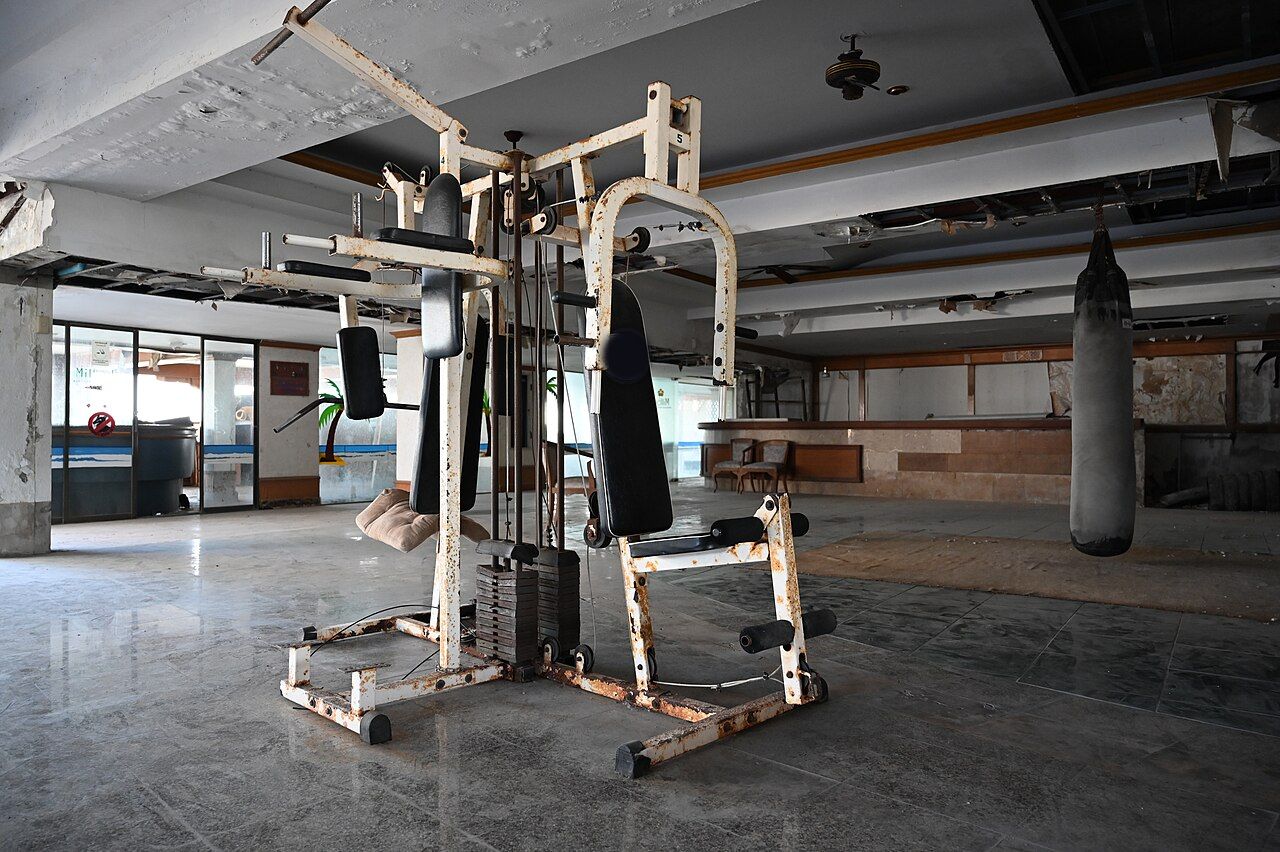
PattayaPatrol · CC BY-SA 4.0 (logo masqué)
Vacation, injury, exams: how long before you lose your muscle? Slower than you fear: two to three weeks off lead to almost no loss, neither in strength nor in muscle size. Beyond that, strength holds up better than volume, and a single training session per week is enough to keep the essentials. After 65, however, the break costs more. Here is what twenty-one studies measure.
"Detraining" is what happens when you completely stop bodybuilding. Researchers measure this by having volunteers train for a few weeks, then stop, and sometimes resume. To know how many training sessions are needed to progress, there is How many training sessions per week to build muscle; here, the question is the reverse: how many are needed not to regress.
What the reviews say
A meta-analysis of 103 studies confirms that stopping causes all components of strength to drop: submaximal strength (effect size −0.62), maximal strength (−0.46) and, less so, power (−0.20). The loss grows with the duration of the stop, and it is more marked in those over 65 and in inactive people than in amateur athletes.
An older review gives the order of magnitude: in humans, strength generally maintains itself up to four weeks of inactivity. Muscle fiber size, on the other hand, drops quickly in strength and sprint athletes, and eccentric strength as well as sport-specific power can drop markedly in highly trained athletes.
A few days to three weeks: almost nothing
In trained athletes, lower body maximal strength did not budge after 3 or 5 days off; upper body strength (an isometric push) held for 3 days, but dropped after 5. In trained men, two weeks off did not lower strength on the leg press, and lean mass was maintained.
In adolescent athletes, three weeks off after twelve weeks of bodybuilding changed neither muscle thickness, nor strength, nor athletic performance; only fat mass went up, and fat-free mass dropped a little. Even in elite powerlifters, fourteen days off did not significantly lower muscle thickness or cross-sectional area: it was explosiveness measurements, such as the reactive strength index on jumping, that decreased.
Not everyone loses at the same rate. In 24 men, those who had grown the most during training (more than 15% cross-sectional area of the vastus lateralis) re-lost 10.5% of this area in six weeks off, while the others lost none. No group had lost maximal strength after the first three weeks.
Several months: strength holds up better than muscle
Over longer breaks, it is muscle volume that melts first, before strength. In a trial of 19 people, the thickness and cross-sectional area of the trained leg's muscle returned to their starting point in twenty weeks off, while strength stayed above. In six trained women, 30 to 32 weeks off changed fiber size little; strength dropped, without returning to the pre-training level.
In beginner men, those who stopped everything for eight weeks lost 22.6% of their one-rep max on the half-squat and 5.4% of quadriceps cross-sectional area.
Loss in %, after 8 weeks of training followed by 8 weeks of complete stop. Beginner men; groups with one or two training sessions per week lost nothing
One training session per week is often enough
The good news is that it doesn't take much to lose nothing. In the same trial, the groups that switched to one or two training sessions per week kept their strength and muscle for eight weeks. In young adults, a third and even a ninth of the starting training volume were enough to keep muscle gain; strength was almost entirely preserved even during the complete stop.
Did you know?
After 60, the break costs more
In the minimal volume trial, the two maintenance doses kept muscle in the young, but not in the elderly, who need a higher weekly volume. In older women, one training session per week for 24 weeks even raised maximal strength by about 5%, but they lost about 5% of quadriceps cross-sectional area.
In elderly men, twelve weeks off caused a loss of 5 to 15% in strength and power, and less than eight weeks of resumption were enough to regain maximal strength. On muscle size, a meta-analysis in seniors sees a non-significant loss between 12 and 24 weeks off, but a significant one between 31 and 52 weeks. And another finds that leg strength stays above the starting level as long as the stop does not last longer than the training that preceded it, and the training lasted at least 24 weeks.
What training brought to daily life also holds: in seniors, part of the functional capacity gained remains present after the stop (effect size 0.87), all the more so as the starting gain was large, and all the less so as the person is elderly. For a dietary supplement studied with bodybuilding after 60, there is creatine in seniors.
Don't bet everything on the resumption
"Muscle memory": what we know
The idea is that an already trained muscle regrows faster. Part of the mechanism is seen in humans: after ten weeks of arm training, the number of myonuclei (the nuclei of muscle cells) increased, then remained maintained during sixteen weeks of cessation, even as the fibres shrank. Another team describes epigenetic memory: certain genes keep the mark of training even though muscle mass has returned to its baseline level.
A memory that remains to be proven in the results
In summary
| Your situation | What the studies say |
|---|---|
| One week off | Lower body strength intact; the upper body may drop slightly after 5 days |
| Two to three weeks | Neither strength nor muscle clearly lost in most trials |
| Five months of doing nothing | Muscle can return to its starting point; strength holds up better |
| Less time to train | One to two training sessions per week maintain strength and muscle |
| Over 60 years old | The loss is greater; you need to maintain more volume |
| Muscle memory | Myonuclei remain; the advantage upon resumption is not demonstrated |
If you have to cut back, switch to one or two full training sessions per week rather than cutting everything out: the training session generator suggests a program based on the number of days you have available. Upon resumption, the 1RM calculator helps you start back with realistic loads.
One, two or three training sessions per week: start from a program adapted to the time you have.
Create my programEvery figure in this article comes from a study you can open: the underlined mentions lead to the summary of the work it is drawn from, written based on the abstract alone. Informative content, which does not replace the advice of a health professional.