Cigarettes and muscle: what tobacco costs your training
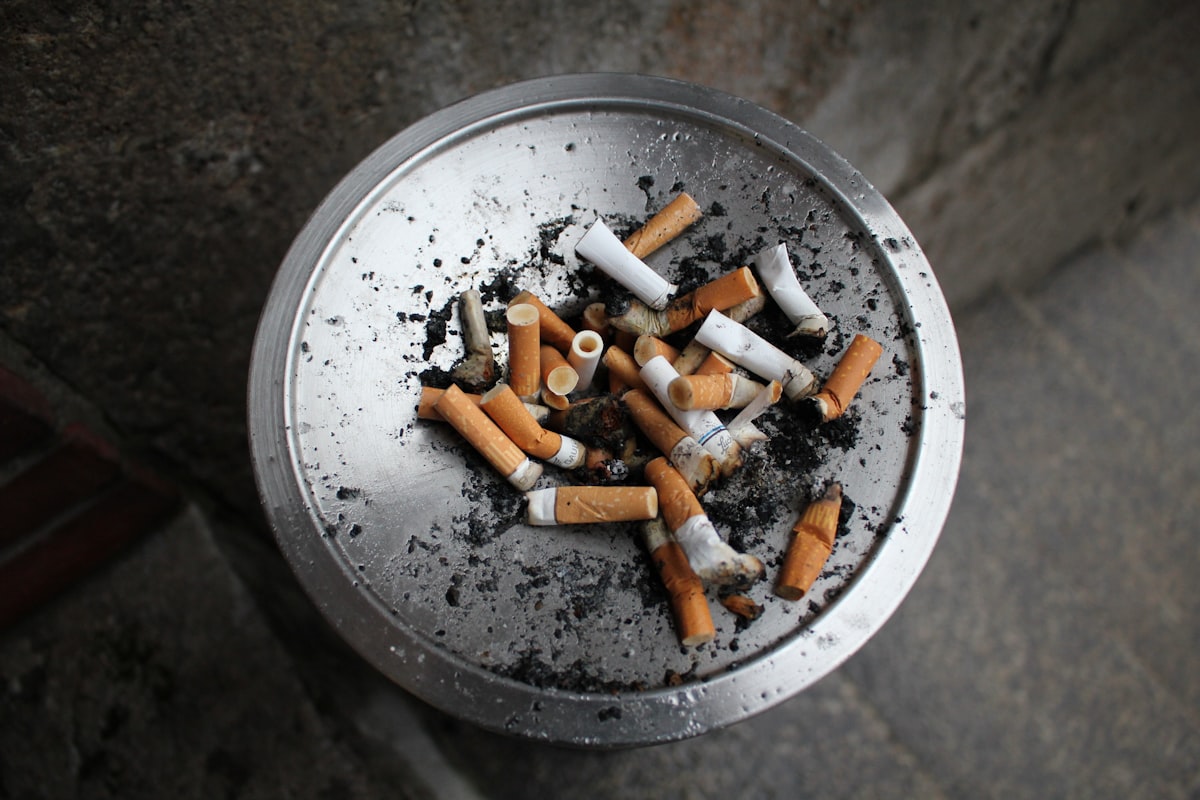
Cigarettes are associated with the lungs and the heart. Much less with muscle. Yet, when researchers went to take muscle samples directly from smokers and non-smokers to measure what happens inside, the gap was clear — and it cannot be explained by breathlessness. Here is what tobacco costs a lifter, and above all what quitting gives back, faster than one thinks.
The most direct measurement
In 2007, a study compared the rate at which muscle builds its proteins in smokers and non-smokers. Not a questionnaire, not an estimate: a direct measurement inside the muscle.
2007 human study (P = 0.004). The error bar shown on each column represents the standard error.
About one-third less synthesis. And the same study looked into why: in the muscle of smokers, myostatin expression was about 33% higher, and MAFbx about 45% higher. These two are respectively the brake on muscle growth and a marker of the destruction machinery. Tobacco therefore acts on both fronts at once: less construction, more demolition.
A 2012 review attempts to assemble these observations into a cellular model: how cigarette smoke acts on muscle protein, and why this translates, at the population scale, into more sarcopenia in smokers.
Less strength — and above all less endurance
A 2008 study on 40 smokers and 45 non-smokers measured a nuanced result, which deserves to be quoted as is: maximum strength and contraction speed did not significantly differ. What did differ was fatigue — markedly greater in smokers.
The proposed explanation is not in the muscle itself but in its supply: the carbon monoxide in the smoke hinders oxygen delivery and mitochondrial function. Your muscle is not weaker on a single rep, it holds out for a shorter time on the set. The 2015 review on the subject reaches the same conclusion: the muscles of asymptomatic smokers are weaker and less resistant to fatigue.
Regarding strength, large studies still find a signal, which is dose-dependent:
| Study | What was measured | Result |
|---|---|---|
| 2012 — longitudinal study, healthy adults | Knee muscle strength | −2.9% in men and −5.0% in women per 100 g of tobacco per week |
| 2012 — 4,249 Japanese men | Grip strength and leg strength | Significant differences beyond significant cumulative exposure, after adjustment for age |
| 2007 — 487 women aged 65 to 77 | Chair stand, timed walk, grip strength | Female smokers take longer on tests and have less strength: an effect equivalent to 7 to 11 years of aging |
What this means over a lifetime
A British cohort following 2,394 people since birth in 1946 linked smoking history to mid-life physical performance: each bracket of 10 pack-years (one pack a day for ten years) was associated with a 0.11 standard deviation drop in the overall physical performance score, with impaired standing balance and chair rise ability.
A 2015 meta-analysis covering 12 studies and 22,515 participants quantified the link with sarcopenia — age-related muscle loss: odds ratio of 1.12 (1.03-1.21) overall, and 1.20 (1.06-1.35) in men. In women, the association went in the same direction (1.21) but without reaching statistical significance (0.92-1.59).
Correlation or causation?
Other muscles, and other smokers
Limb muscle is not the only thing affected. In 68 boys aged 15 to 18, all respiratory tests — chest expansion, pulmonary function, respiratory muscle strength — were worse in smokers. And the effect does not take years: after a single 45-minute shisha session, the oxygen consumption of 24 healthy men dropped from 1.86 to 1.70 L/min.
In people who are already ill, the gap becomes very concrete. In 38 smokers with lower limb arterial disease, compared to 100 ex-smokers, claudication pain came on 1 min 37 s sooner when walking. And in 392 patients with rheumatoid arthritis, active smokers had a lower BMI and fat mass than ex-smokers and non-smokers — a reminder that "leaner" does not mean "in better shape".
The counter-intuitive result: testosterone
Here is something surprising. A study of 3,427 men found that smokers had total testosterone that was 15% higher and free testosterone that was 13% higher compared to those who had never smoked — and that it increased with the number of cigarettes per day.
This is not a measurement fluke: a 2016 meta-analysis covering 22 studies and 13,317 men finds the same direction (mean difference of +1.53 nmol/L). In women, however, no clear association.
This is an excellent lesson in methodology. Smokers have more testosterone and yet less muscle, less strength and less endurance. An isolated hormonal figure says nothing about the final result — what matters is what the muscle does, not what the blood shows.
What quitting gives back, and how fast
This is the most encouraging part of this literature, and it happens faster than one might think. A 2021 study followed 48 smokers for 14 days of cessation: skeletal muscle fatigue resistance improved significantly (p < 0.001), and several inflammatory markers (IL-4, IL-6, IL-10) returned towards the values of non-smokers.
Two weeks. Over a year, the balance sheet is even broader — a longitudinal study of 41 ex-smokers measured:
| After 12 months without tobacco | What is gained |
|---|---|
| Lean mass | +1.26 kg |
| Grip strength | +3.6 kg |
| Bench press (estimated 1RM) | +7.85 kg |
| Leg press (estimated 1RM) | +17.02 kg |
| Total body weight | +4.43 kg, including +3.15 kg of fat mass |
The weight gain that often accompanies quitting is real — but it is not just fat: over one kilo of lean mass comes back with it. And the 2015 review puts it clearly: many of the effects of tobacco on skeletal muscle are likely reversible after quitting.
In summary
| Question | What the studies say |
|---|---|
| Does smoking slow down muscle building? | Yes: protein synthesis at 0.037 vs 0.059 %/h, with more myostatin and MAFbx |
| Will I be weaker? | On a one-rep max, not necessarily. On fatigue resistance, yes, significantly |
| Why? | Carbon monoxide hinders oxygen delivery and mitochondrial function |
| And in the long term? | Increased risk of sarcopenia (odds ratio 1.12), causal link confirmed in 2023 |
| What about testosterone? | Higher in smokers (+15 %) — and it makes them neither more muscular nor stronger |
| If I quit? | 14 days are enough to improve fatigue resistance; over one year, +1.26 kg of lean mass |
The key takeaway is not meant to make you feel guilty, it is practical: if you smoke and train, it is not your one-rep max that betrays you first, it is your work capacity. And that is precisely what comes back the fastest when you quit.
If fatigue resistance is the weak point, training volume must be built up progressively. Following a program session after session lets you see this progress in black and white.
View my programsAlong the same lines of habits that weigh on results, we also looked at what alcohol really costs muscle.
Every figure in this article comes from a study you can open: the underlined mentions lead to the work from which the result is drawn. These summaries are written solely from the abstract. Several of these works are observational and compare groups that also differ in other lifestyle habits; the 2023 Mendelian randomization study is the one that comes closest to a causal demonstration. Informative content, which does not replace medical advice. To quit smoking, a doctor, a pharmacist or Tabac info service can support you.