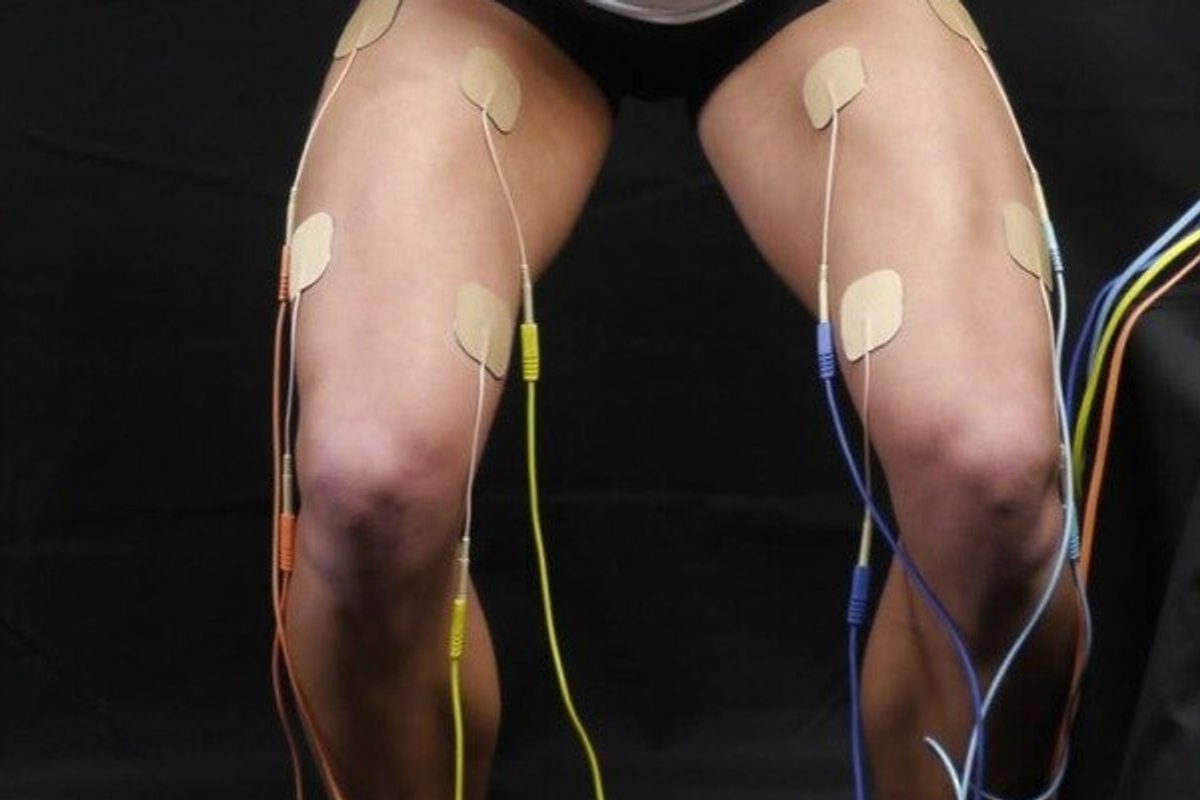
Electrostimulation: muscle without lifting iron?
By Kalorya · November 12, 2026 · 7 min read
Gciriani · CC BY-SA 4.0 (recadrée)
Gym electrode suit, home abdominal belt: does electrostimulation build muscle without lifting heavy weights? In someone who does not train, yes, a little: some strength and a little muscle, roughly like traditional weight training, according to meta-analyses. But it does no better than weight training, it adds almost nothing in an already trained athlete, and it does not melt fat. Here is what twenty-one studies say.
In non-athletes: a real effect on muscle and strength
Whole-body electrostimulation (known as WB-EMS) is practiced in an electrode suit for about twenty minutes while performing simple movements. The 2021 meta-analysis brings together 16 studies and 897 participants who are not athletes: it finds a significant effect on muscle mass and on the maximal strength of the legs and back. A systematic review of 23 articles also concludes with more muscle and better physical capabilities, and judges it safe when well supervised.
The effect is seen even in older adults. In 75 women over 70 who were overweight and lacked muscle, a 20-minute session per week increased muscle mass. In 100 men of the same age, electrostimulation combined with protein outperformed no training on handgrip strength and fat. And in 8 people aged 65 and over, 8 weeks of electrostimulation of the thighs and lower back increased thigh muscle cross-sectional area by 11.4%. And in 30 postmenopausal women who were already exercising, adding electrostimulation for 14 weeks increased leg strength by 9.6%, whereas it dropped by 4.5% in those who kept their usual training.
Did you know?
Compared to weight training: no better
The real question is the comparison with weight training. A meta-analysis of 19 studies on healthy people, at equal training volume, finds practically identical strength gains between electrostimulation and traditional weight training. In 48 untrained men aged 30 to 50, 16 weeks of electrostimulation or intense weight training resulted in muscle and strength gains in both groups, with no significant difference between them.
Randomized trial, 48 untrained men aged 30 to 50 (2016); differences between groups not significant
Same observation elsewhere. In 40 young adults, biceps thickness increased in 8 weeks with electrostimulation, weight training, or both together, neither doing better than the other; combining both added nothing. In 89 sedentary adults around fifty years old, adding electrostimulation to high-intensity interval training did not do better, in 12 weeks, than interval training alone or than the WHO-recommended training. And for the thighs, a review of 32 trials in young adults finds that electrostimulation strengthens the quadriceps, but less than voluntary weight training; on muscle size, trials are divided (3 positive, 3 negative).
In athletes: very little extra
The 2026 meta-analysis in athletes finds a favorable effect on maximal strength and power. But when electrostimulation is added to usual training, and compared to that same training alone, the effect is no longer significant. Five trials in moderately trained young adults point in the same direction: a negligible effect on leg strength and vertical jump, a small effect on sprint. An older review of 89 trials in athletes reported gains in strength, jump, and sprint after 3 to 6 weeks, but its figures are the best results from isolated trials ("up to"), not an average. A review of 10 studies in healthy adults notes strength gains in all, but no improvement in functional tests related to that strength.
What about fat?
It is the most sold promise, and the least kept. The 2021 meta-analysis finds no significant effect on fat mass. During a session, in 19 men, electrostimulation burns 412 kcal instead of 352: a real but small effect, which the authors themselves do not deem sufficient to make it a weight-loss tool. Another team, in 16 people, measures more: an intense session would increase resting energy expenditure by about 25% in the hours and days that follow, or about 460 kcal more than the control group. But over time, fat does not follow. In 90 overweight women on a diet for 16 weeks, all lost more than 2 kg of fat, with or without electrostimulation, with no difference between groups; lean mass increased slightly in the stimulated group (387 g), but this change was not significant.
"Iron beats electricity"
The risks
Whole-body electrostimulation places heavy demands on the muscle. The 2023 international recommendations remind us that several scientific and press articles have reported serious adverse effects. They call for close and constant supervision by a qualified trainer, a questionnaire on contraindications before starting, a cautious first session for the beginner, and enough rest between two sessions. In practice: no full-intensity session the first time, and a real recovery delay between two sessions.
The limits, all the same
In practice
If you cannot or do not want to lift weights, supervised electrostimulation will help you gain a little strength and muscle, as trials compared to weight training show. If you can train, traditional weight training does at least as well, costs less and improves your health more, according to the trial in obese individuals. To lose fat, the key lever remains the caloric deficit: read what really works to lose weight and calculate yours with the calorie calculator. To start weight training, the workout generator offers you a routine, and weight training after 60 shows what you can still gain at any age.
Summary
| Your question | What the studies say |
|---|---|
| Does it build muscle without training? | A little, in non-athletes and the elderly (meta-analysis of 16 studies) |
| Better than weight training? | No: practically identical strength gains at equal volume (19 studies) |
| Useful for the already trained athlete? | Little: non-significant effect when added to regular training |
| Does it make you lose weight? | No: no effect on fat mass in the meta-analysis |
| The abdominal belt? | A stronger and firmer belly, but not less fat |
| Is it risk-free? | Only when supervised, with progressive buildup and rest between sessions |
If your goal is to lose fat, start by knowing how much you eat: the calorie calculator gives you your starting point.
Weight training does at least as well as electricity: put together a session tailored to your level.
Generate my workoutEvery figure in this article comes from a study you can open: the underlined mentions lead to the summary of the work it is taken from, written from the abstract alone. Informative content, which does not replace the advice of a health professional.